

Introduction
This article explains the several types of cloud computing: public, private, and hybrid.
Cloud technology has changed how businesses work, store information, and offer services. Companies of all sizes, from small businesses to large corporations, are moving their infrastructure to the cloud to make it more scalable, flexible, and cost-effective. But before you make the switch, you should learn about the many forms of cloud computing and how each one works.
In this in-depth tutorial, we’ll look closely at public, private, and hybrid cloud models, weigh their pros and cons, give real-world examples, and help you decide which one is ideal for your business.
What does “cloud computing” mean?
Cloud computing is the supply of computer services over the internet. These services include servers, storage, databases, networking, software, and analytics. Businesses rent computing resources from cloud providers on demand instead of owning their own gear.
Organizations can choose the best deployment model for their needs in terms of security, budget, performance, and compliance if they know the many types of cloud computing.
Overview of the Three Main Types of Cloud Computing
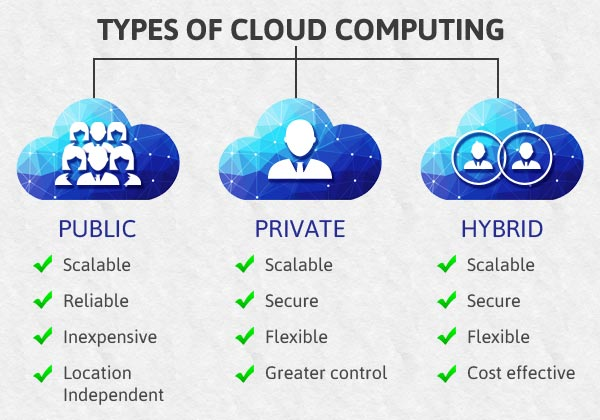
There are three main ways to deploy:
-
Cloud for Everyone
-
Cloud for Private Use
-
Cloud that is both public and private
Different models give you varied levels of control, security, and scalability. The sort of types of cloud computing you choose depends a lot on your business goals and technological needs.
What is Public Cloud?
A public cloud is a cloud environment where services are shared by many clients and distributed over the public internet. A third-party provider owns and runs the infrastructure.
Some well-known public cloud providers are:
-
Amazon Web Services
-
Microsoft Azure
-
Google Cloud Platform
These companies have data centers all over the world, infrastructure that can grow with your needs, and pricing that lets you pay as you go.
Important Things About Public Cloud
-
Providing resources on demand
-
Pay-per-use pricing model
-
Very scalable
-
No need to maintain hardware
-
Architecture for several tenants
Benefits of Public Cloud
1. Affordable
No need to buy hardware or data centers.
2. Ability to grow
Based on demand, resources can automatically scale.
3. Simple to set up
You can start services in only a few minutes.
4. Access from anywhere in the world
Get to apps from anywhere that has an internet connection.
Drawbacks of the Public Cloud
-
Customization is limited
-
Infrastructure that is shared
-
Possible problems with compliance
-
Concerns about where data is stored
Best Uses
-
Small enterprises and startups
-
Apps for the web
-
Environments for development and testing
-
Platforms based on SaaS
Public cloud is one of the most popular types of cloud computing since it is cheap and easy to use.
What is a Private Cloud?
A private cloud is only for one business. It can be hosted on-site or by a third party, but other users can’t use the same infrastructure.
Important Things About Private Cloud
-
Single-tenant space
-
More options for customisation
-
Better security controls
-
Infrastructure that is set aside
Advantages of Private Cloud
1. More safety
Great for industries that have rules and sensitive data.
2. Personalization
Infrastructure that fits the needs of each business.
3. Following the rules
Easier to meet rigorous rules for compliance.
Drawbacks of Private Cloud
-
More expensive
-
Needs IT knowledge
-
Responsibility for maintenance
Best Uses
-
Banks and other financial entities
-
Organizations that provide health care
-
Agencies of the government
-
Businesses that need to follow rigorous rules
Private cloud is the sort of types of cloud computing that gives you the most control and security.
What is Hybrid Cloud?
Hybrid cloud is a mix of public and private cloud environments that lets data and apps flow across them.
How the Hybrid Cloud Works
Companies utilize private cloud for tasks that need to be kept secret and public cloud for projects that need to be able to grow. Integration tools and APIs make it easy for both environments to work together.
Advantages of Hybrid Cloud
1. The ability to change
Run tasks where they function best.
2. Cost Optimization
Use the public cloud for tasks that need a lot of power.
3. Better safety
Store private information in a private cloud.
4. Keeping the business going
It’s easier to set up backup and disaster recovery systems.
Problems with Hybrid Cloud
-
Difficult management
-
Integration challenges
-
More costs for running the business
Hybrid cloud is becoming more and more popular as a sort of cloud computing because it strikes a good mix between cost, security, and performance.
Comparison of Cloud Deployment Models
Feature Comparison Table
| Feature | Public Cloud | Private Cloud | Hybrid Cloud |
|---|---|---|---|
| Cost | Low | High | Medium |
| Scalability | Very High | Moderate | High |
| Security | Shared | Very High | High |
| Customization | Limited | Extensive | Flexible |
| Maintenance | Provider | Organization | Shared |
| Best For | Startups | Enterprises | Growing Businesses |
This comparison makes it easy to choose the right form of types of cloud computing for your organization.
What are Cloud Service Models?
When talking about deployment models, it’s also crucial to know about service models:
Infrastructure as a Service (IaaS)
Offers virtualized computer resources over the web.
For example:
-
Machines that are not real
-
Systems for storage
-
Infrastructure for networking
Platform as a Service (PaaS)
Gives you a place to build, test, and deploy apps without having to worry about the infrastructure.
SaaS, or Software as a Service
Provides software applications over the internet for a monthly fee.
CRM systems, email platforms, and tools for working together are some examples.
All types of cloud computing use service models.
How to Pick the Best Cloud Model
When choosing between different types of cloud computing, you need to think about:
1. Money
The public cloud is cheaper than the private cloud, which needs a bigger investment.
2. Needs for safety
Private or hybrid cloud may be needed for sensitive data.
3. Needs for Scalability
Businesses that grow quickly can use public or hybrid cloud.
4. Rules for compliance
The healthcare and financial industries could like private cloud better.
5. IT Tools
Managed public cloud services may be helpful for small IT teams.
Situations in the Real World
Scenario 1: A startup is making an app.
Public cloud is the best solution because it is cheap and can grow with your needs.
Scenario 2: The bank is in charge of financial data.
Private cloud is the best choice for security and compliance.
Scenario 3: E-commerce Platform at Its Busiest
The best option is a hybrid cloud for short-term scaling.
The advantages of knowing about cloud deployment models
Knowing the many types of cloud computing lets you:
-
Planning costs better
-
Better ways to keep things safe
-
Improved performance
-
Following the rules
-
Quick recovery from disasters
Companies that properly look at their cloud deployment alternatives lower their risk and make their systems more scalable in the long run.
What will happen in the future of cloud computing
1. Strategies for Multiple Clouds
Companies employ more than one public cloud provider to lower their reliance on one.
2. Integrating Edge Computing
Processing data closer to users will lower latency.
3. Putting AI and the Cloud together
Cloud platforms that work with machine learning technologies.
4. Architecture without servers
Developers only have to worry about code, not servers.
As technology gets better, the types of cloud computing keep changing.
What are the three types of cloud computing?
Answer: There are three types of cloud computing:
-
Cloud for Everyone
-
Cloud for Private Use
-
Cloud that is a mix of both
Each model has its own rules about who owns it, how easy it is to scale, how secure it is, and how much it costs.
What is the safest cloud model?
Answer: The private cloud is usually thought to be the safest option because the infrastructure is only for one company. However, the hybrid cloud can also be quite safe if set up correctly.
Questions that are often asked
1. What are the types of cloud computing?
The main types of deployment models include public, private, and hybrid cloud.
2. What kind of cloud is ideal for small businesses?
The public cloud is usually the best choice because it is cheap and can grow with your needs.
3. Does hybrid cloud cost a lot?
Depending on how complicated the infrastructure and integration are, it can be relatively pricey.
4. Is it possible for a business to change cloud models later?
Yes, a lot of firms switch between different types of cloud computing as their needs change.
Conclusion
To make smart choices about technology, you need to know what types of cloud computing there are. Public cloud is cheap and easy to scale up, private cloud is more secure and gives you more control, and hybrid cloud is flexible and balanced.
Each business has its own demands, so picking the correct model depends on things like budget, compliance, scalability, and operational goals. As digital transformation moves faster, picking the right cloud deployment model will be very important for long-term success.
When you plan your cloud journey, the first thing you should do is figure out what your workload needs are and find the proper cloud model for them. Making the proper choice today can have a big effect on performance, cost-effectiveness, and security tomorrow.
Read More:-Top 7 Essential Features That Define Modern Cloud Computing